EXECUTIVE
INTERVIEW
Interview
with DaimlerChrysler’s Prof.
Kohler
by John McCormick
An
engineering graduate from Stuttgart
University, Prof. Dr. Kohler joined
Daimler-Benz AG in 1976. As vice
president, body and powertrain research,
and chief environmental officer,
he is responsible for DaimlerChrysler
AG’s propulsion, body, materials
and production technology, as well
as environmental policies.
|
Question:
What is your strategy in terms
of fuel cell vehicles?
Answer:
“Today we are focused
on conventional powertrains,
but if you look back at the
history of energy it is always
an evolutionary process from
one technology to the next.
So we will stay with conventional
powertrains and in parallel
to that we will have more
and more cars with alternative
powertrains, with special
focus on fuel cell vehicles.
As far as meeting the goal
of zero emission vehicles,
there is no doubt the fuel
cell is the best option and
also for using energy most
efficiently in comparison
to a conventional powertrain.”
|
|
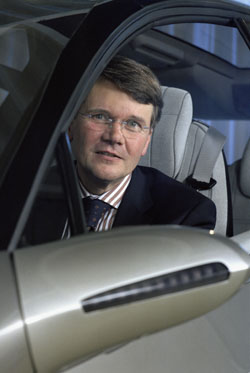
Prof. Dr. Kohler
|
Question:
What progress are you making with
the development of hydrogen fuel
cell vehicles?
Answer:
“Our progress with fuel cell
propulsion systems over the past
10 years has been very intensive
and very good. On the other hand
we know there are still deficits
regarding reliability and cold start.
However we have the technology to
solve the cold start problem. It
is feasible to minus 20 deg., where
you can drive the vehicle within
one second and have 80 percent of
the energy after 30 seconds.”
Question:
What about the cost problems associated
with fuel cells?
Answer:
“Cost is always related to
the high technology and materials.
But if we compare the situation
versus three years ago, we have
been able to reduce costs by 90
percent. We still have to make further
drastic reductions, focusing especially
on the platinum we are using as
a catalyst in the fuel cells. The
intention is to lower costs using
thinner layers and better production
methods.”
Question:
What is your opinion of the most
promising hydrogen storage methods?
Answer:
“Currently we have fuel cell
vehicles with 300-400kms range.
We’re making progress but
it is not good enough. We see technologies
that will get us to 500kms, which
will be in common with normal propulsion
systems.
“On the compressed hydrogen
side, we are looking at pressures
up to 750 bar, and we are looking
at the possibilities on the liquid
storage side. We know the problems
- losses from liquid to gaseous
phases – but there is the
possibility for greater driving
range. This is a game that is not
over yet.
“As
for the storage tanks it’s
important to find a better geometric
construction than we have today.
A cylinder is not that efficient
a shape to accommodate in a car.
So we are looking at least to flatten
the side of the cylinder in order
to package more efficiently.”
Question:
Do you believe in hybrid fuel cell
vehicles, ie. the need for a buffer
battery?
Answer:
“It’s a trade between
cost, weight and energy consumption
advantage and disadvantage. There
are some good reasons from the technical
side to use the hybrid approach.
You can reduce stack size and costs,
but you have additional weight and
packaging issues. There is the question
of the fuel cell process; its real
strength is to work at constant
production rate. In stop and start
driving, the question is: do you
shut down the fuel cell? It’s
not that easy and what effect does
it have on stack lifetime? So there
is a good reason to combine with
a battery. But is it good idea that
two complicated systems are combined
together? One of the most costly
areas of hybrids is battery integration.”
|